
How to Source Products from China: A 7-Step Sourcing Agent's Guide (2025)
You have a brilliant product idea, and you know that manufacturing in China offers a powerful path to bring it to life at a competitive cost. But a single, daunting question stands in your way: How do you actually source products from China?
The process can seem like a black box of complex steps, potential scams, and logistical nightmares. For new importers, it’s easy to feel overwhelmed.
As a professional sourcing agency, we live and breathe this process every day. We’ve navigated the challenges and built the systems to turn ideas into successful products. This is not a theoretical overview; this is our battle-tested, 7-step framework that demystifies the entire journey.
This ultimate guide will serve as your roadmap, breaking down the entire sourcing process from start to finish.
The 7-Step China Sourcing Process
Here is the step-by-step journey every successful product takes, from a simple idea to a shipment arriving at your warehouse.
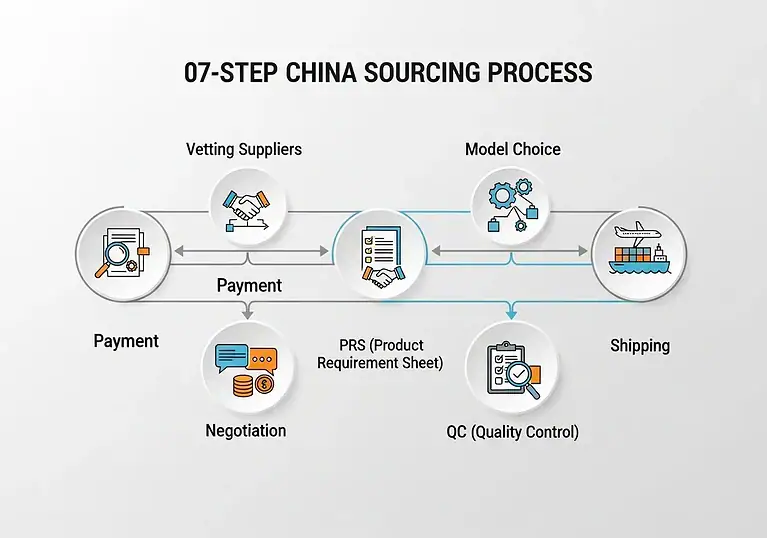
Step 1: Find and Vet Reliable Suppliers
This is the most critical foundation of your entire business. Finding a supplier is easy; finding the right one is the hard part. This stage is about separating the professional factories from the unreliable traders. It involves deep background checks, verifying licenses, and confirming their real capabilities.
A mistake at this stage can be catastrophic. That’s why we’ve dedicated an entire guide to our professional vetting methodology.
-> For a deep dive, read our complete guide on How to Find and Vet Reliable Suppliers in China.
Step 2: Choose Your Manufacturing Model (OEM vs. ODM)
Before you can get a price, you need to decide how your product will be made. Will you provide a custom design, or will you put your brand on a factory’s existing product? This is the strategic choice between OEM and ODM.
- OEM (Original Equipment Manufacturer): You design it, they build it. You own the IP.
- ODM (Original Design Manufacturer): They design it, you brand it. The factory owns the IP.
This decision impacts your costs, time-to-market, and competitive advantage.
-> To understand the critical differences, check out our detailed comparison: OEM vs. ODM: Choosing the Right Manufacturing Model.
Step 3: Create Your Blueprint (The Product Specification Sheet)
“Can you make this, but a bit bigger and in blue?” This kind of vague request leads to disaster. To get accurate quotes and the exact product you want, you need a professional Product Specification Sheet (PRS). This document is your product’s “legal blueprint,” defining every material, dimension, color, and function.
-> Learn how to create a document that leaves no room for error with our guide: How to Write a Product Specification Sheet (PRS).
Step 4: Master the Art of Price Negotiation
Negotiation in China is not about aggressive haggling; it’s a nuanced dance of value. The goal isn’t just to get the lowest price (which often leads to the lowest quality), but to achieve the best overall terms. This includes payment terms, packaging, and building a long-term relationship.
-> To secure better deals without sacrificing quality, read our guide with seven pro tips on How to Negotiate Price with Chinese Suppliers.
Step 5: Secure Your Payment Safely
Sending a large sum of money overseas is the most nerve-wracking step for any importer. Understanding the different payment methods, standard payment terms (like the 30/70 split), and common scams is essential to protect your capital.
-> For a complete breakdown of T/T vs. Alibaba Trade Assurance and how to avoid scams, read our guide: How to Pay Chinese Suppliers Safely.
Step 6: Guarantee Your Quality with AQL Inspection
How do you ensure that the 5,000 units in a warehouse in China meet your standards before paying the final balance? The answer is a Pre-Shipment Inspection using the AQL (Acceptance Quality Limit) standard. This statistical method is the global language of quality control.
-> Demystify this crucial process with our simple guide: What is AQL Sampling? A Guide to Quality Inspection.
Step 7: Arrange Your International Shipping
Once your goods pass inspection, the final step is getting them home. This involves choosing between sea and air freight, finding a reliable freight forwarder, and navigating customs clearance. This is a complex field in its own right.
-> To understand the entire logistics journey, read our ultimate guide on Shipping from China.
A Sourcing Agent's Perspective: It's a Cycle, Not a Straight Line
From our experience, the biggest mistake new importers make is seeing these seven steps as a simple, linear checklist. In reality, it’s a dynamic cycle. The results of your quality inspection (Step 6) might force you to renegotiate (Step 4). The choice of an OEM model (Step 2) will heavily influence your PRS (Step 3).
A professional sourcing partner doesn’t just execute these steps; we manage the entire cycle, anticipating problems and leveraging our experience to ensure a smooth, efficient process from start to finish.
Frequently Asked Questions (FAQ) about Sourcing from China
Q1: How much money do I need to start sourcing from China?
It depends heavily on the product. For a simple product with a low MOQ, you might start with a budget of $3,000 – $5,000 for your first inventory order. For a custom product requiring a new mold (OEM), the upfront tooling costs alone can be $2,000 – $10,000+.
Q2: How long does the entire sourcing process take?
For a simple ODM product, from finding a supplier to receiving your first shipment by sea, a realistic timeline is 3 to 4 months. For a custom OEM product, it can easily be 6 to 12 months due to the longer product development and prototyping phase.
Q3: Do I need to visit China to source products?
In 2025, it is not strictly necessary for most products. With tools like video call audits, detailed PRS documents, and reliable third-party inspection services (or a sourcing agent on the ground), you can successfully manage the entire process remotely.
Q4: What is the single most significant risk when sourcing from China?
The most significant risk is not a single scam, but a lack of a systematic process. The most common failure point is choosing a supplier based on the lowest price alone, without conducting proper vetting (Step 1) and quality control (Step 6).
Conclusion: Your Process Defines Your Success
How to source from China is not a secret; it’s a process. By following these seven steps, you transform sourcing from a risky gamble into a structured, manageable business function.
Each step is a link in a chain, and the strength of your business depends on the strength of each link.
Feeling overwhelmed by the process? That’s what we’re here for.
Our end-to-end Product Sourcing service is designed to manage this entire 7-step journey for you. Schedule a free consultation with our sourcing experts and let us turn your product idea into a reality, safely and efficiently.
Table of Contents
Share: