
Fishing Rod Materials Explained: A Pro Guide to Carbon Fiber vs. Fiberglass
For any fishing brand, the “blank”—the core shaft of the rod—is the product’s soul. The material used to construct that blank defines the rod’s performance, its feel in the hand, and its place in the market. The two dominant materials in the modern fishing industry are Fiberglass and Carbon Fiber (often marketed as Graphite).
Choosing between them is a critical strategic decision. It’s not just about technical specs; it’s about defining who your customer is and what your brand stands for.
As a sourcing agency that works with specialized sporting goods manufacturers, we’ve created this technical guide to break down the science and practical applications of these fishing rod materials. This guide will help you make informed decisions for your Product Development.
The Core Fishing Rod Materials: A Head-to-Head Comparison
Let’s compare the two main materials across the key performance characteristics that anglers and product developers care about most.
| Characteristic | Fiberglass | Carbon Fiber (Graphite) | Winner for… |
| Sensitivity | Low | Very High | Feeling subtle bites (e.g., jigging for walleye). |
| Durability | Extremely High | Lower (more brittle) | Tough applications, beginner anglers, boat rods. |
| Weight | Heavy | Very Light | Long casting sessions, reducing angler fatigue. |
| Action (Flex) | Slower (bends more parabolically) | Faster (bends more at the tip) | Fast hook sets, casting accuracy. |
| Cost | Low | High | Entry-level and budget-conscious products. |
A Deep Dive into Fiberglass: The Durable Workhorse
Fiberglass was the industry standard for decades. It’s made by weaving glass fibers into a cloth, which is then impregnated with resin and rolled into a blank.
The Key Advantage of Fiberglass: Durability
The standout quality of fiberglass is its incredible toughness. It’s ideal for:
- Charter boat rental rods
- Rods for tough fighting fish (like catfish or heavy saltwater species)
- Crankbait fishing, where the slower, more parabolic action helps fish inhale the lure and prevents treble hooks from tearing out.
The Main Disadvantage: Weight & Low Sensitivity
The trade-off for durability is weight and feel. Fiberglass rods are noticeably heavier and far less sensitive than carbon fiber rods, making it difficult to detect subtle bites.
A Deep Dive into Carbon Fiber (Graphite): The High-Performance Champion
Carbon fiber revolutionized the industry with its incredible stiffness-to-weight ratio. The key to understanding carbon fiber fishing rod performance is the concept of Modulus.
Understanding Modulus in Fishing Rod Materials
- What it is: Modulus refers to the stiffness of the carbon fibers. A higher modulus means stiffer fibers.
- Why it matters: Stiffer fibers allow designers to use less material to achieve the same rod power, resulting in a lighter, thinner, and more sensitive blank.
Beyond the Fiber: The Importance of Resin, Weave, and Wall Thickness
While Modulus gets the marketing attention, a rod’s performance is a complex interplay of factors, a topic often discussed in depth on technical forums like TackleTour.
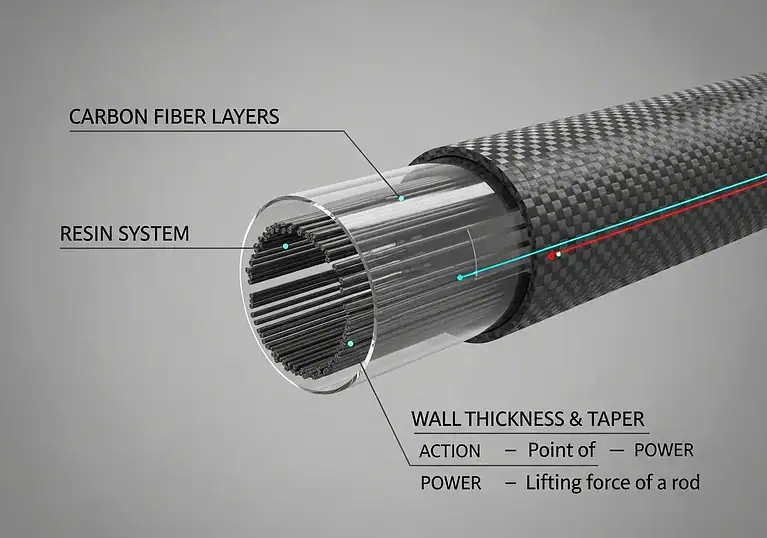
- Resin Systems: The resin is the glue holding the carbon fibers together. Modern nano-resin systems create a denser, stronger blank without adding weight.
- Fiber Weave: The pattern of the carbon cloth (e.g., cross-weaves) adds hoop strength and prevents the blank from ovalizing under load.
- Wall Thickness & Taper: These design elements are what truly determine the rod’s Action (how much it bends) and Power (how much force it takes to bend it).
Case Study: Choosing the Right Material for a Client's Bass Rod Line
Carbon fiber revolutionized the industry with its incredible stiffness-to-weight ratio. The key to understanding carbon fiber fishing rod performance is the concept of Modulus.
Understanding Modulus in Fishing Rod Materials
- What it is: Modulus refers to the stiffness of the carbon fibers. A higher modulus means stiffer fibers.
- Why it matters: Stiffer fibers allow designers to use less material to achieve the same rod power, resulting in a lighter, thinner, and more sensitive blank.
The Situation: A client wanted to launch a new line of bass fishing rods. They were tempted by a supplier offering a very low price on a “100% Carbon” rod.
Our Vetting & Analysis:
- Material Inquiry: We requested the spec sheet. The “100% Carbon” was a low-grade, 24-Ton carbon with a heavy, older-generation resin system.
- Sample Testing: We ordered samples. The rod was light but felt “dead” and lacked crispness. In a stress test, it snapped below its expected load rating, indicating poor construction.
- The Solution: We advised the client to invest slightly more in a 30-ton carbon blank with a proven nano-resin system. We worked with a different supplier to develop a prototype.
- The Outcome: The final product was 15% lighter, significantly more sensitive, and passed all durability tests. While the unit cost was 20% higher, the client was able to market it as a premium, high-performance rod at a higher retail price, leading to greater profitability and better brand positioning. This is a real-world example of how a deeper understanding of fishing rod materials leads to a better product.
Sourcing & Quality Control: An Agent's Perspective
When working with a fishing rod manufacturer, your Quality Inspection must be rigorous.
- Material Verification: How do you know you’re getting 30-Ton carbon and not 24-Ton? This requires a trustworthy supplier and, for large orders, may involve third-party material testing.
- Spine Alignment Checks: Every rod blank has a “spine.” Guides must be aligned correctly along this spine for optimal casting performance. A misaligned spine is a significant defect.
- Component & Finish Inspection: Check the quality of the guides, reel seat, and handle, and look for defects in the epoxy coating.
Frequently Asked Questions (FAQ) about Fishing Rod Materials
Q1: Is graphite the same as carbon fiber in fishing rods?
Yes. In the fishing industry, the terms “graphite” and “carbon fiber” are used interchangeably to refer to the same material. “Graphite” is a standard marketing term.
Q2: Is a more expensive, high-modulus rod always better?
Not always. A high-modulus rod is better for applications requiring extreme sensitivity (like finesse fishing). However, for applications that require durability or a slower action (like crankbait fishing), a lower modulus carbon or even a composite rod is often the superior and more practical choice.
Q3: What do IM6, IM7, etc., mean on a fishing rod?
These are historical trade names (originally from the Hexcel company) that have become a shorthand way to refer to different levels of modulus. While there’s no perfect universal standard, IM6 generally corresponds to 24-30 Ton carbon, while IM7 is in the 30-40 Ton range, and so on.
Conclusion: Material Science is the Key to Performance
Choosing the right fishing rod materials is a strategic decision that defines your product’s place in the market. It’s a critical balance of performance, durability, and cost that should be clearly defined in your Product Specification Sheet.
A deep understanding of these materials allows you to have more technical, productive conversations with your suppliers and, ultimately, to create a product that delivers a real performance advantage to your customers.
Looking to develop your own line of high-performance fishing gear?
Schedule a free consultation with our sourcing experts. We connect you with specialized manufacturers and manage the technical details to bring your vision to life.
Table of Contents
Share: